The Hope of Cheadle: The Spitfire Paid for by the People of The Staffordshire Moorlands
Discover the remarkable story of the Hope of Cheadle, the community-funded Spitfire of the Second World War, and learn what to expect at Cheadle Spitfire Day on Saturday 6th June.

This Saturday, the streets of Cheadle, Staffordshire, will echo with memories of one of the most remarkable community achievements in the history of the Staffordshire Moorlands.
Between 12pm and 4pm, Cheadle High Street and Market Square will host Cheadle Spitfire Day, a celebration of local history, community spirit and the story of the Hope of Cheadle, the Supermarine Spitfire funded by ordinary people across the district during the darkest days of the Second World War.
Visitors can expect live music, period military vehicles, wartime entertainment and a hand-built reproduction Spitfire taking pride of place in the town centre. Yet behind tomorrow's festivities lies a story that deserves to be remembered in its own right.

High Street, CheadleThis postcard view looks north-east along the High Street in Cheadle. On the right is the former Cheadle branch of the Leek and Moorlands Co-operative Society Ltd. store, which is currently (February ...View Full Resource on Staffordshire Past Track
When Cheadle Answered the Call
The summer of 1940 was one of the most dangerous periods in British history.
France had fallen. German forces dominated much of mainland Europe. The threat of invasion hung over Britain, and the Battle of Britain was about to begin.
Across the country, towns and villages searched for ways to contribute to the war effort. In Cheadle and the surrounding villages, local leaders proposed something ambitious: raising enough money to purchase a Spitfire fighter aircraft for the Royal Air Force.
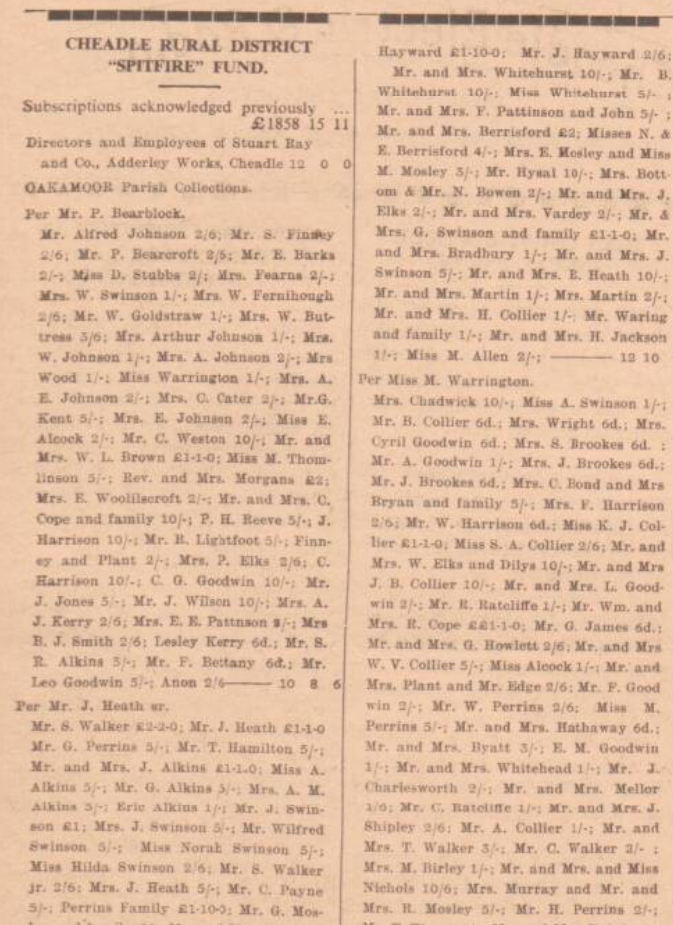
On 30 August 1940, the Cheadle and Tean Times reported that Cheadle Rural District Council chairman J. W. Steele had been asked to establish a Spitfire Fund.
The target was daunting. A new Spitfire cost £5,000, a figure equivalent to roughly three-quarters of a million pounds today. For a largely rural district already living under wartime restrictions, it was a formidable challenge.
Steele nevertheless urged residents to support the campaign.
"This means no less a sum than £5,000, which is a very large sum for an industrial district to raise. Nevertheless, I feel we ought to make a determined effort; I should not like to think that Cheadle has been found wanting."
The district responded magnificently.
Every Street Played Its Part
The fundraising campaign quickly became a community-wide effort.
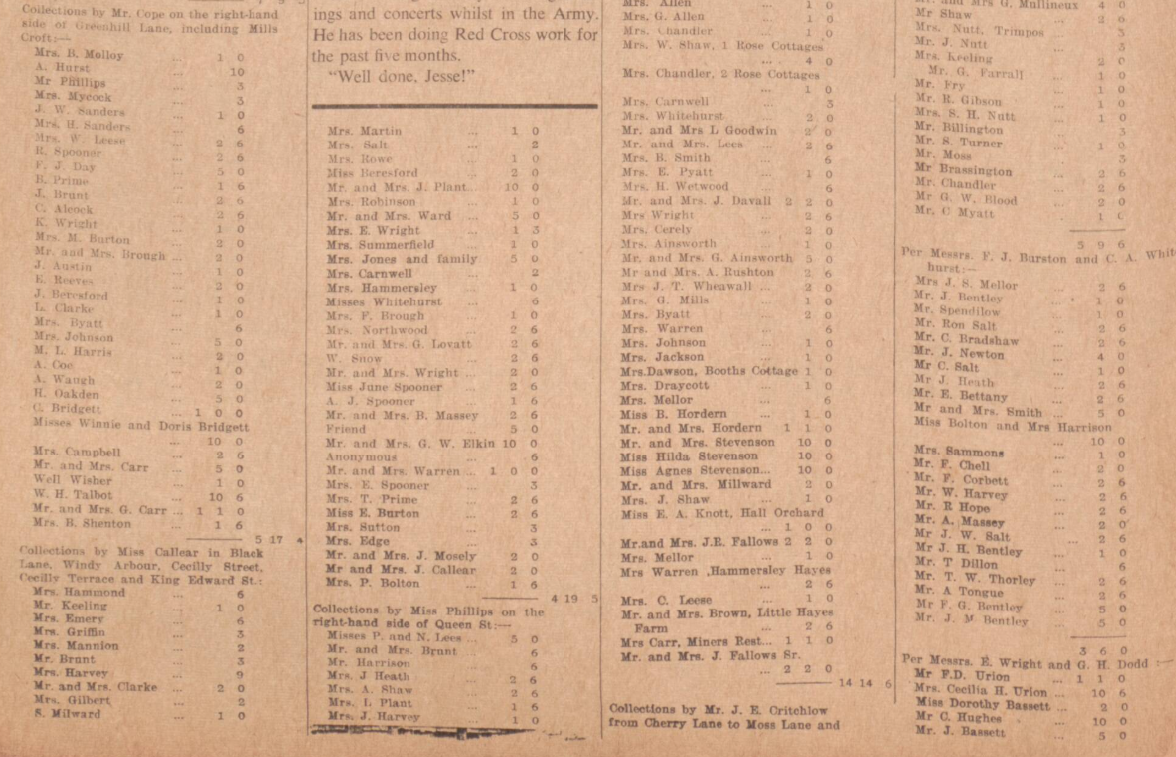
Week after week, the pages of the Cheadle and Tean Times carried long lists of contributors. Today those reports provide a fascinating snapshot of wartime life across the district.
Collectors went door to door throughout Cheadle, Tean and the surrounding villages. Newspapers recorded which roads and neighbourhoods each volunteer covered. Residents could see exactly how the campaign was progressing and who was helping to reach the target.
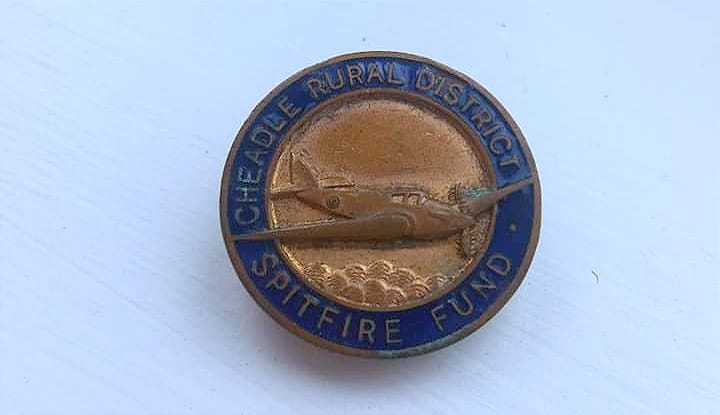
Money arrived in countless ways. Whist drives, dances, concerts, badge sales, collections and rummage sales all contributed to the growing fund. Schools became involved. Local organisations organised events. Businesses donated what they could.
The campaign reflected a wartime Britain where every contribution mattered. No single donation bought the aircraft. Instead, thousands of small acts of generosity combined to achieve something extraordinary.
A Staffordshire Connection
For local people, the Spitfire was more than Britain's most famous fighter aircraft, it was also a North Staffordshire success story.
The aircraft's designer, Reginald Joseph Mitchell, was born at Butt Lane near Kidsgrove in 1895. He attended school in Stoke-on-Trent and began his engineering career in the Potteries before joining Supermarine.
Mitchell died in 1937 before the Second World War began, never seeing the aircraft's greatest triumphs. Yet his creation would become a symbol of Britain's resistance and one of the most celebrated aircraft in aviation history.
For the people of Cheadle, supporting the Spitfire meant supporting an aircraft designed by one of North Staffordshire's own.
The Hope of Cheadle
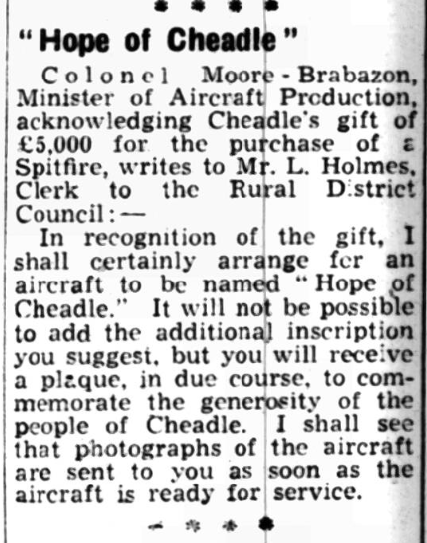
By late 1941, the fundraising target had effectively been achieved and attention then turned to naming the aircraft. Several suggestions were considered before a unanimous decision was reached. The chosen name was The Hope of Cheadle.
To recognise the wider area's contribution, "Staffs. R.D." was added to acknowledge the villages and communities that had helped make the project possible.
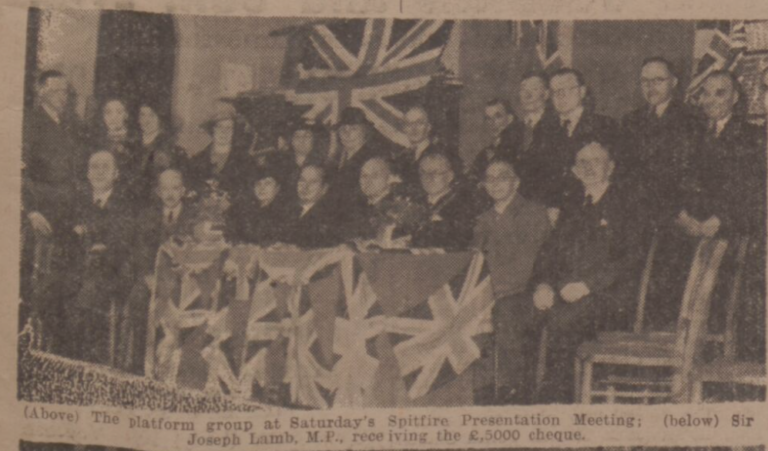
The official presentation of the fund took place in January 1942 at the Wesley Schoolroom. Local dignitaries, volunteers and supporters gathered to celebrate the achievement. The occasion reflected a sense of pride not simply in purchasing an aircraft, but in proving what a determined community could accomplish when working together.
One humorous moment came when a mock telegram was read aloud.
"Greviously disappointed result spitfire effort stop give a chap a chance."
The sender was listed as Adolf Hitler. The joke drew laughter and captured the defiant spirit that helped sustain communities throughout the war.
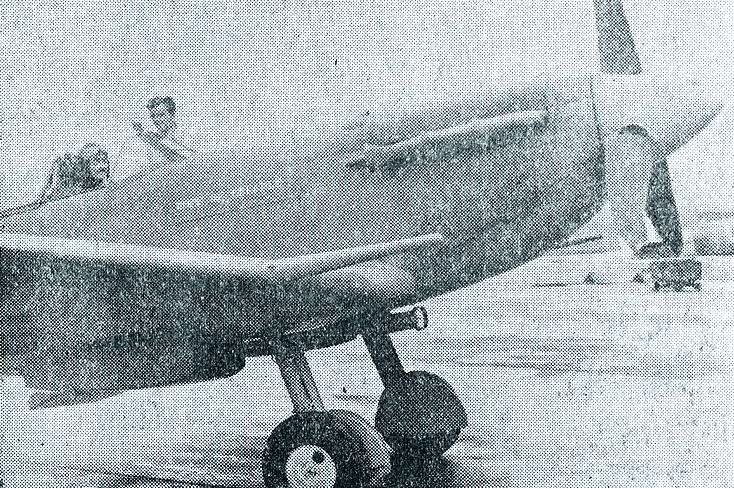
The Plane the People Purchased
The Hope of Cheadle was a Supermarine Spitfire Mk VB built at the Castle Bromwich Aircraft Factory near Birmingham, one of Britain's most important wartime manufacturing sites.
For local people, however, it was never simply another aircraft leaving a production line. It was their Spitfire.
Schoolchildren had contributed, shopkeepers had contributed, families living with rationing had contributed, villages throughout the district had contributed. The aircraft became a symbol of collective effort and shared sacrifice.
Sadly, its operational life was short.
In June 1942, the Hope of Cheadle was lost during operations over occupied France near Étretat in Normandy. Like thousands of wartime aircraft, it became one of the many casualties of the air war over Europe.
Yet while the aircraft itself disappeared, the story behind it survived.
A Legacy Worth Celebrating
More than eighty years later, the Hope of Cheadle remains one of the finest examples of community spirit in the history of the Staffordshire Moorlands.
Tomorrow's Cheadle Spitfire Day has been organised by the Cheadle Discovery Group, with support from the National Lottery Heritage Fund, to ensure that story is not forgotten.
The day begins at noon with a proclamation from Cheadle Town Crier Paul Lucas, using words written by pupils from Cheadle Primary School.
Visitors will be able to see a hand-built reproduction Spitfire in Market Square, enjoy performances from local choirs and musicians, watch traditional entertainment and explore displays of military vehicles supplied by members of the North Staffordshire Military Vehicle Association.
Many businesses are also decorating their shop windows in a 1940s style, and visitors are encouraged to dress in period clothing to help recreate the atmosphere of wartime Britain.
More importantly, it offers an opportunity to remember the thousands of ordinary men, women and children who dug deep during Britain's darkest hour and succeeded in purchasing a fighter aircraft that carried the name of their town.
The Spitfire may be gone, but the Hope of Cheadle endures.
Cheadle Spitfire Day takes place on Saturday 6 June from 12pm until 4pm in Cheadle High Street and Market Square. Admission is free.
 Jenna Goodwin
Don't forget to head over to The Staffordshire Signal for news, events and our Staffordshire magazine!