The Shugborough Inscription: Is the location of the Holy Grail Hidden in a Staffordshire Garden?
Ten carved letters at Shugborough Hall have baffled Darwin, Dickens and Bletchley Park for 250 years. The full story of Staffordshire's unsolved code. Is it a Holy Grail Clue, Oak Island Treasure Map, or a Staffordshire Love Letter?

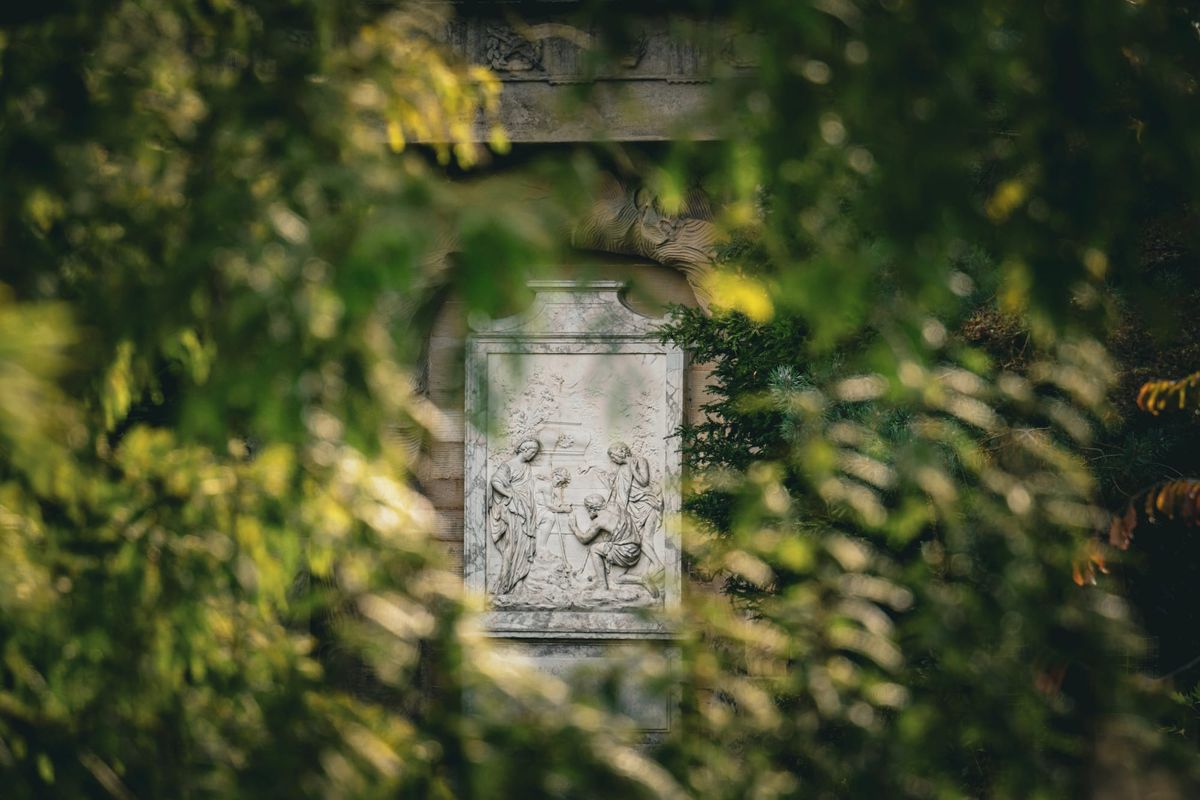
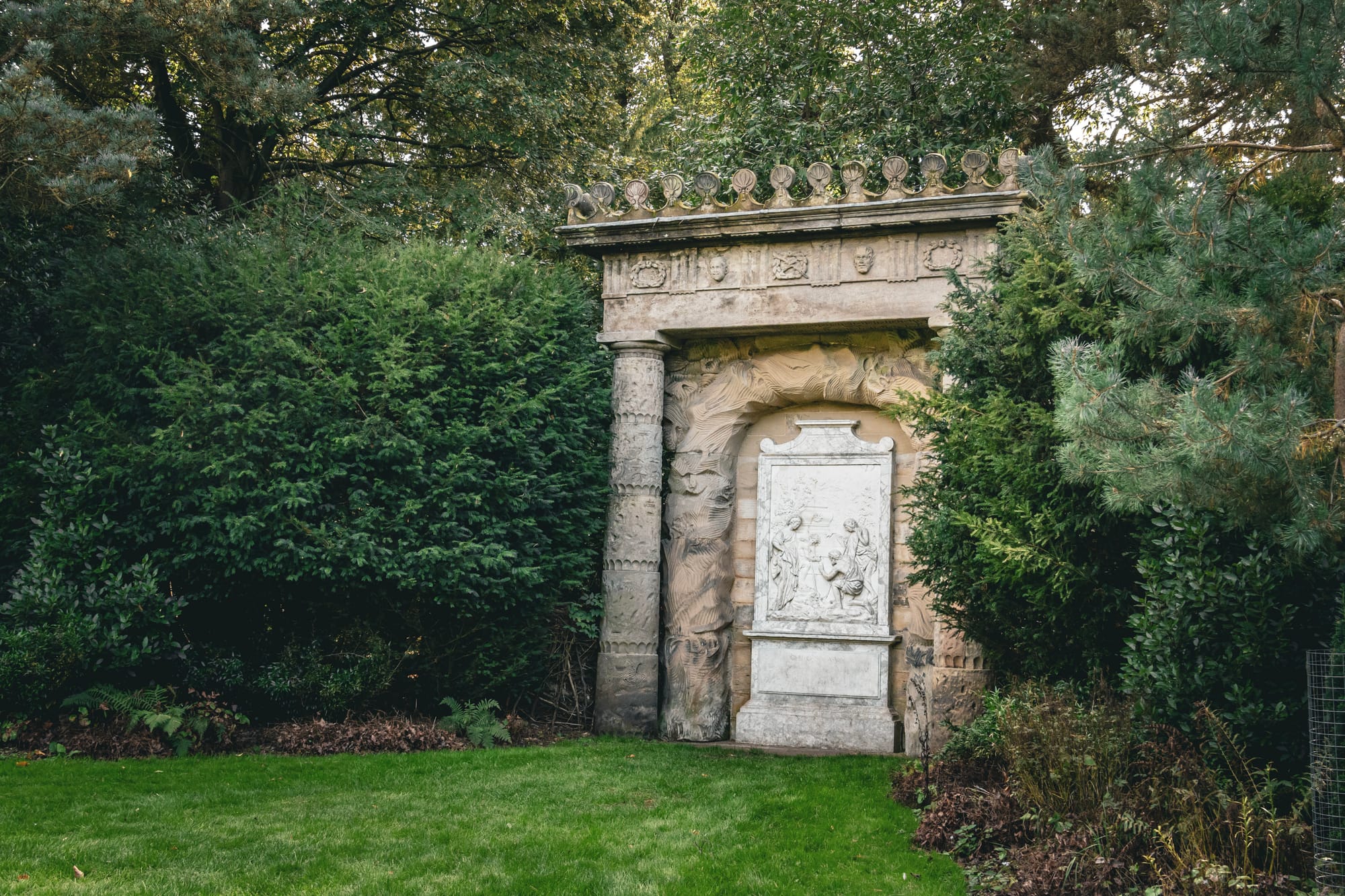
In a shaded hollow beside the River Sow, in the gardens of Shugborough Hall near Stafford, stands an 18th-century stone arch with a marble carving inside it and ten letters cut into the plaque below:
O U O S V A V V, with a D and an M beneath.
For more than 250 years nobody has been able to say for certain what they mean. Josiah Wedgwood studied them. So did Charles Darwin and Charles Dickens. In 2004 the estate brought in wartime codebreakers from Bletchley Park, and they couldn't crack it either. The National Trust still receives five or six solutions a week from around the world.
Along the way, the Shepherd's Monument has been linked to the Knights Templar, the Priory of Sion, buried Spanish gold and the Holy Grail. Here is what we actually know.

Thomas AnsonA portrait, believed to be of Thomas Anson (1695-1773) of Shugborough. Thomas inherited the Shugborough estate in 1720 and was the elder brother of Admiral George Anson. He was an educated man, travelling ...View Full Resource on Staffordshire Past Track
The Ansons and the Spanish treasure
Shugborough in the 1740s belonged to Thomas Anson (c.1695 to 1773), MP for Lichfield, classical scholar and a founding member of the Society of Dilettanti. He had travelled far beyond the usual Grand Tour, to Cairo, Aleppo and the ruins of Palmyra, and in 1748 carried secret diplomatic correspondence to Versailles for the government.
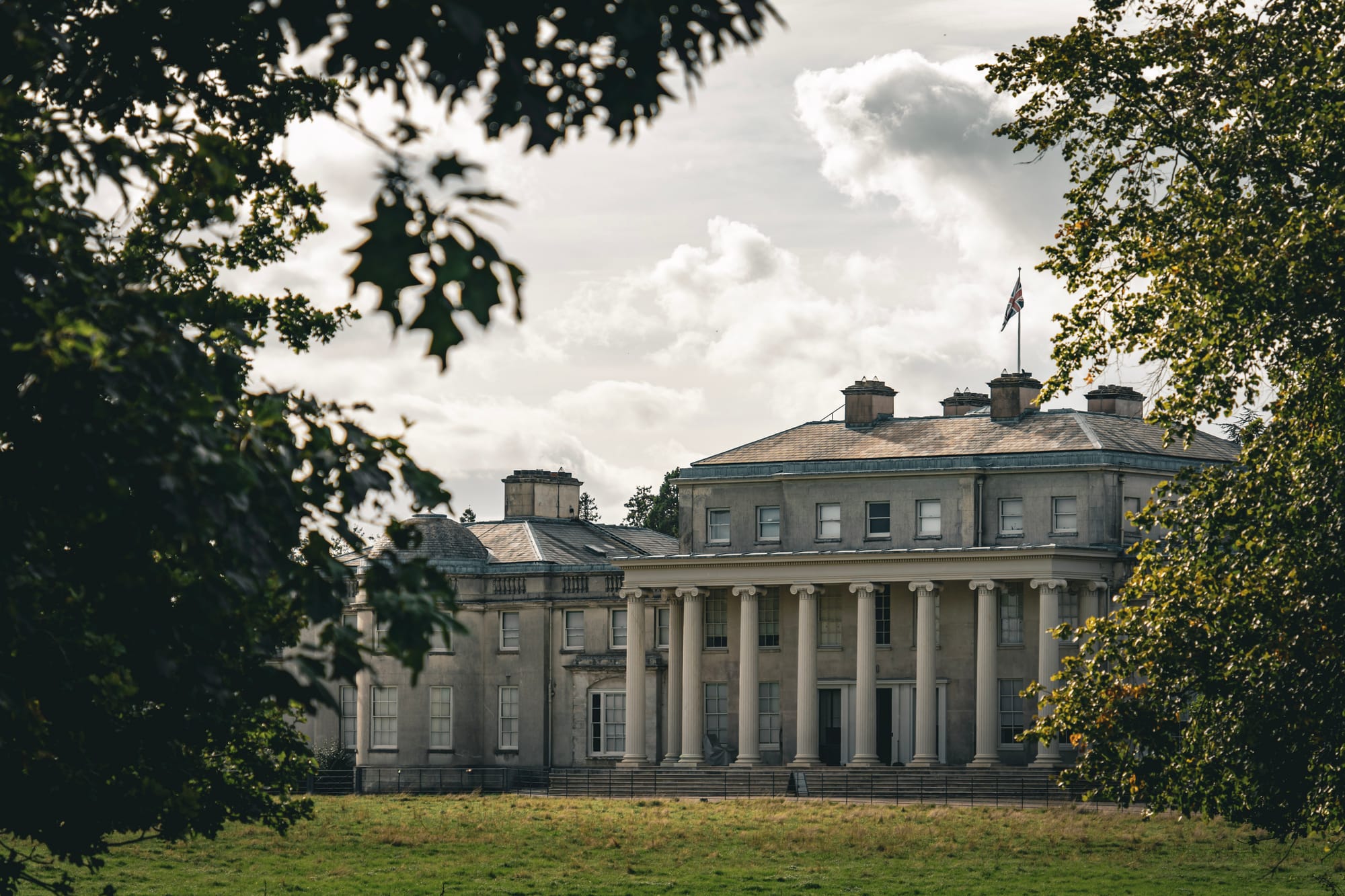
The money came from his younger brother. George Anson sailed round the world between 1740 and 1744 aboard HMS Centurion and captured the Spanish treasure galleon Nuestra Senora de Covadonga off the Philippines, one of the richest prizes in naval history. He returned a national hero, later became First Lord of the Admiralty, and his fortune paid for the transformation of Shugborough's park into a landscape of classical temples, arches and follies.
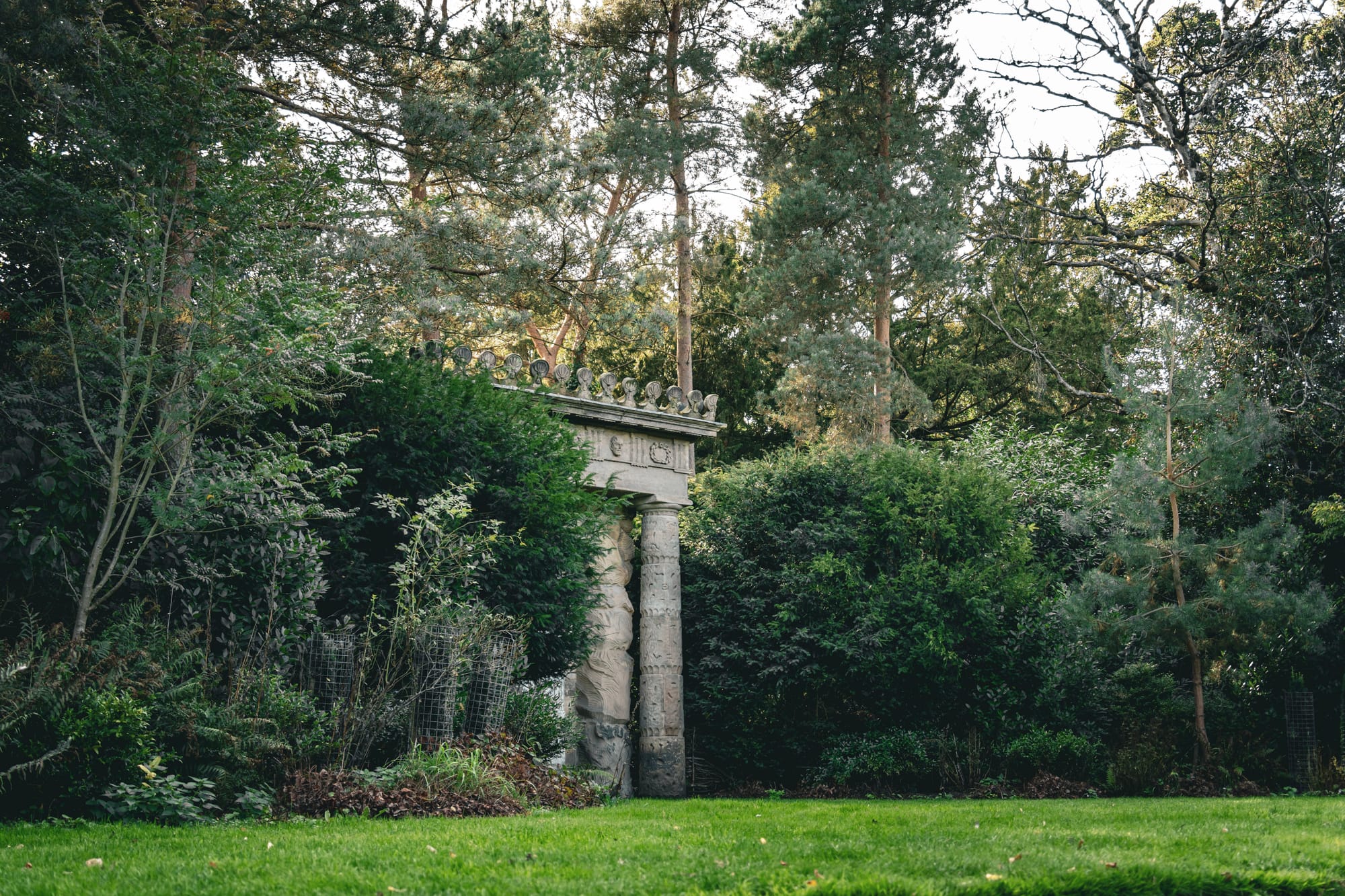
The Shepherd's Monument was built in two stages. The first, between about 1748 and 1756, was a rustic stone arch designed to resemble a grotto, taken from a plan by Thomas Wright, the Durham astronomer and architect, and published in his 1755 book Six Original Designs of Arbours. Wright had drawn it to be built from timber, which explains the unusual swirling stonework: a mason translating a wooden design into rock.
Around 1763 a classical portico with two Doric columns was added to the front, attributed to James "Athenian" Stuart, who also designed Shugborough's Tower of the Winds and Triumphal Arch. Its frieze carries two carved heads, one a smiling bald man, the other the horned face of Pan. Neither has ever been explained.
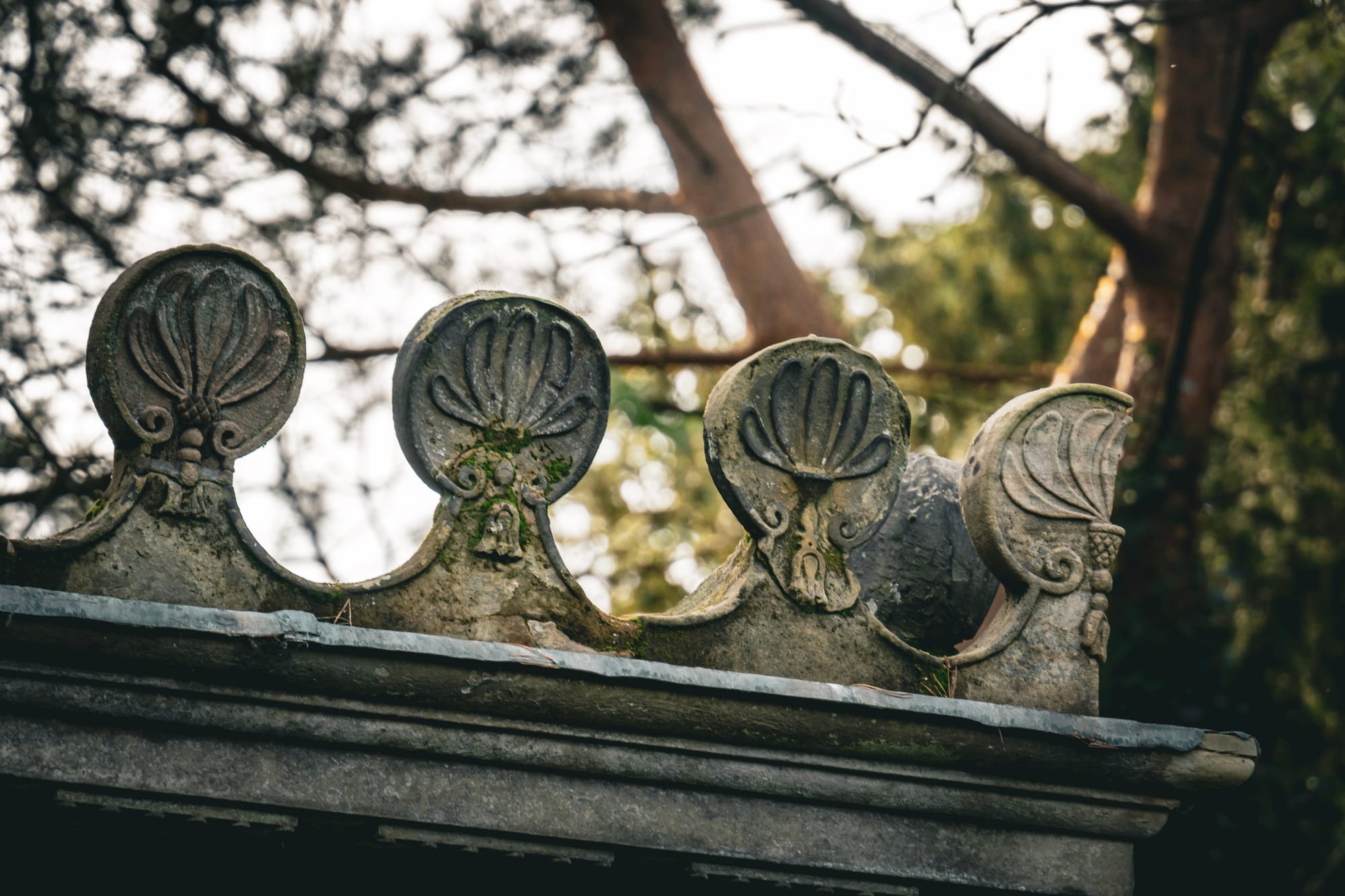
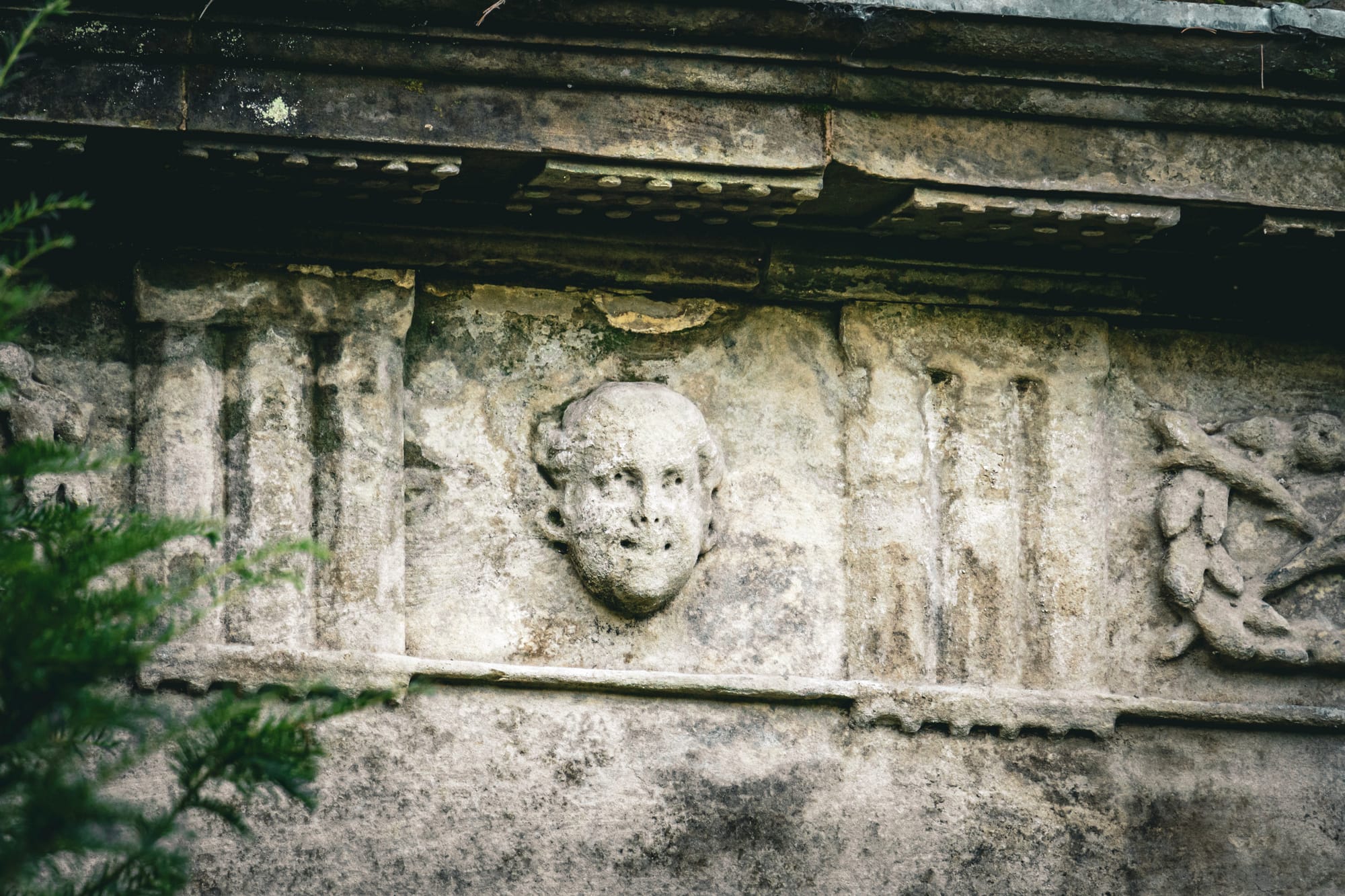
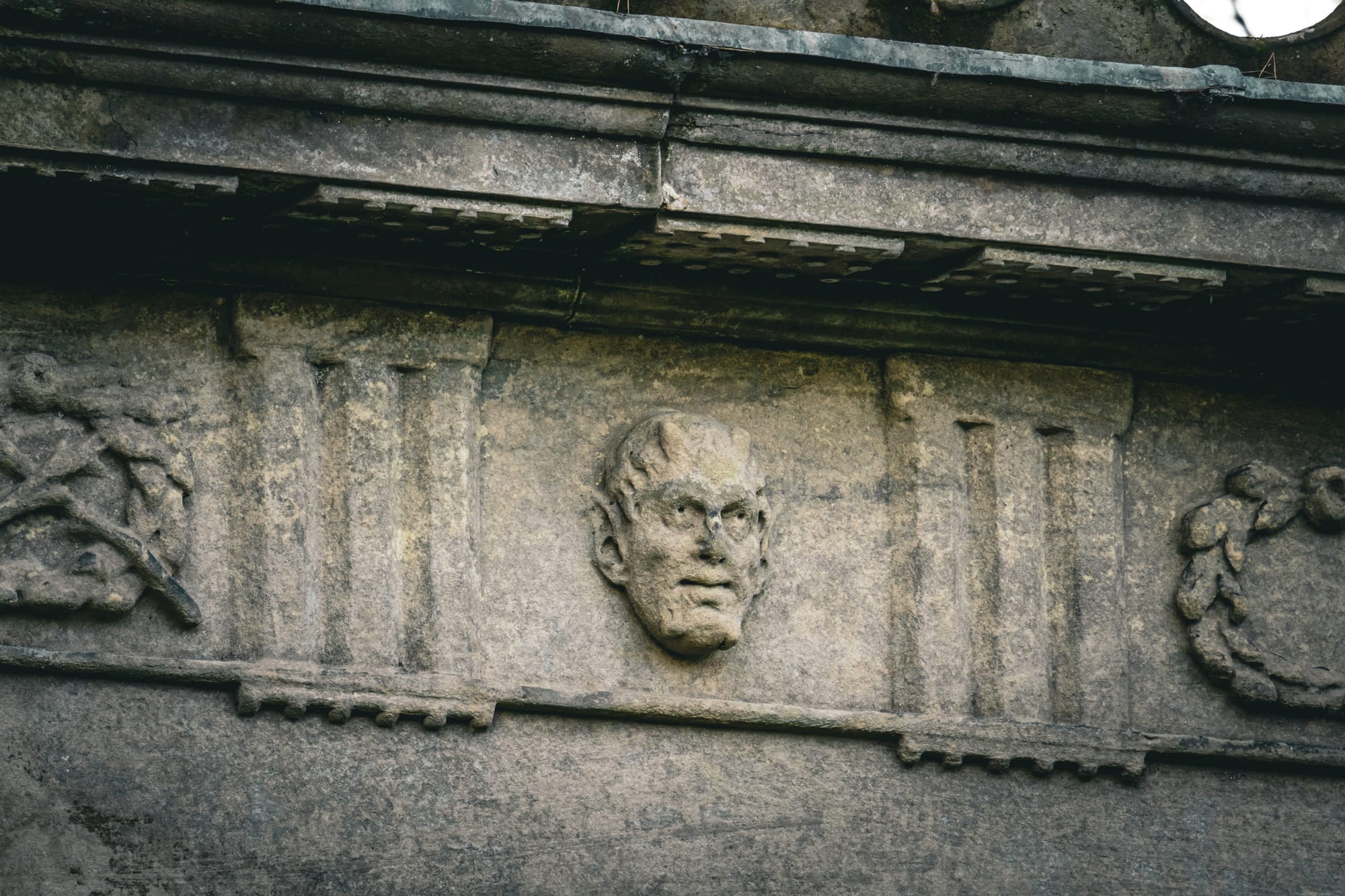
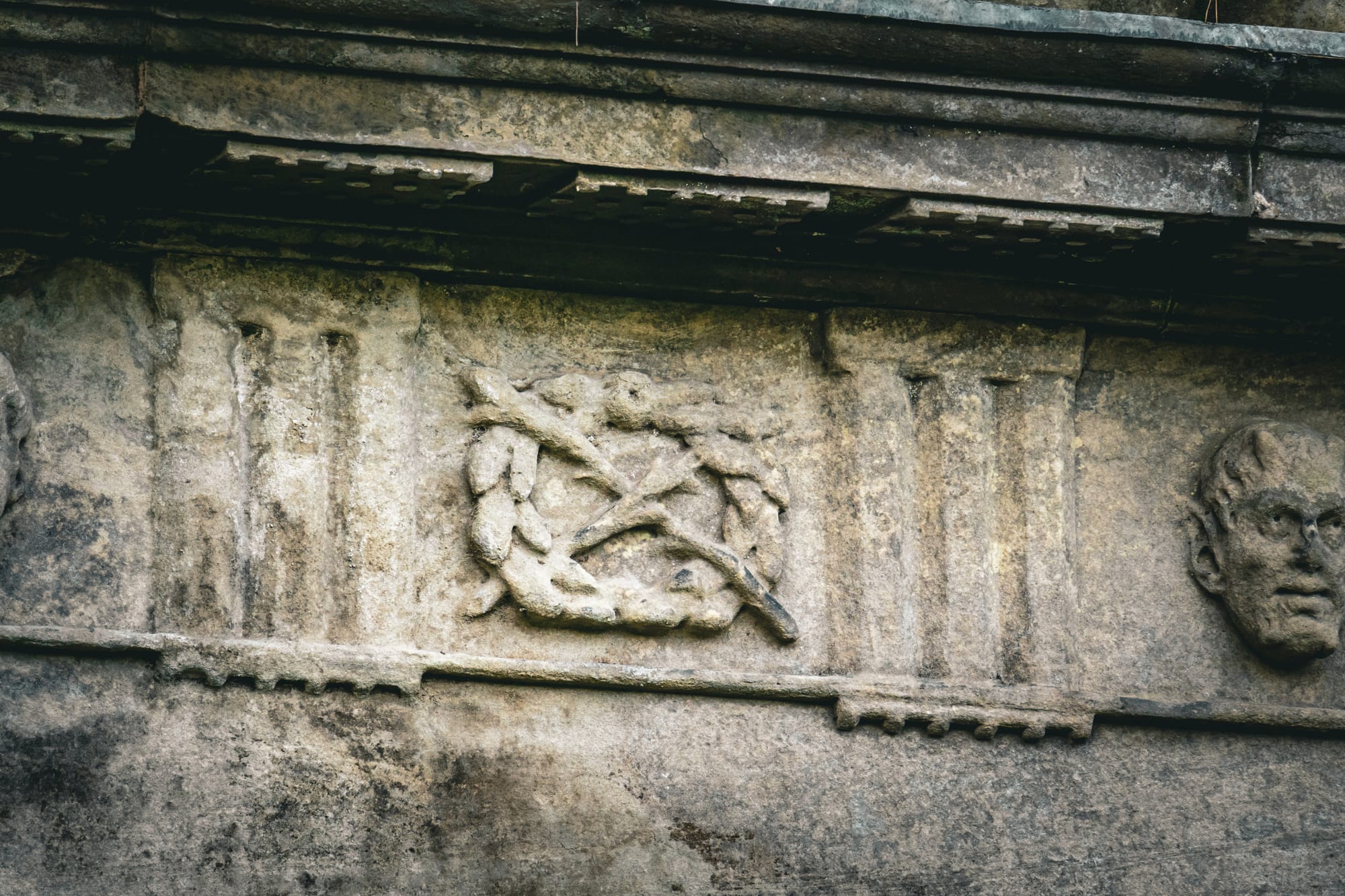
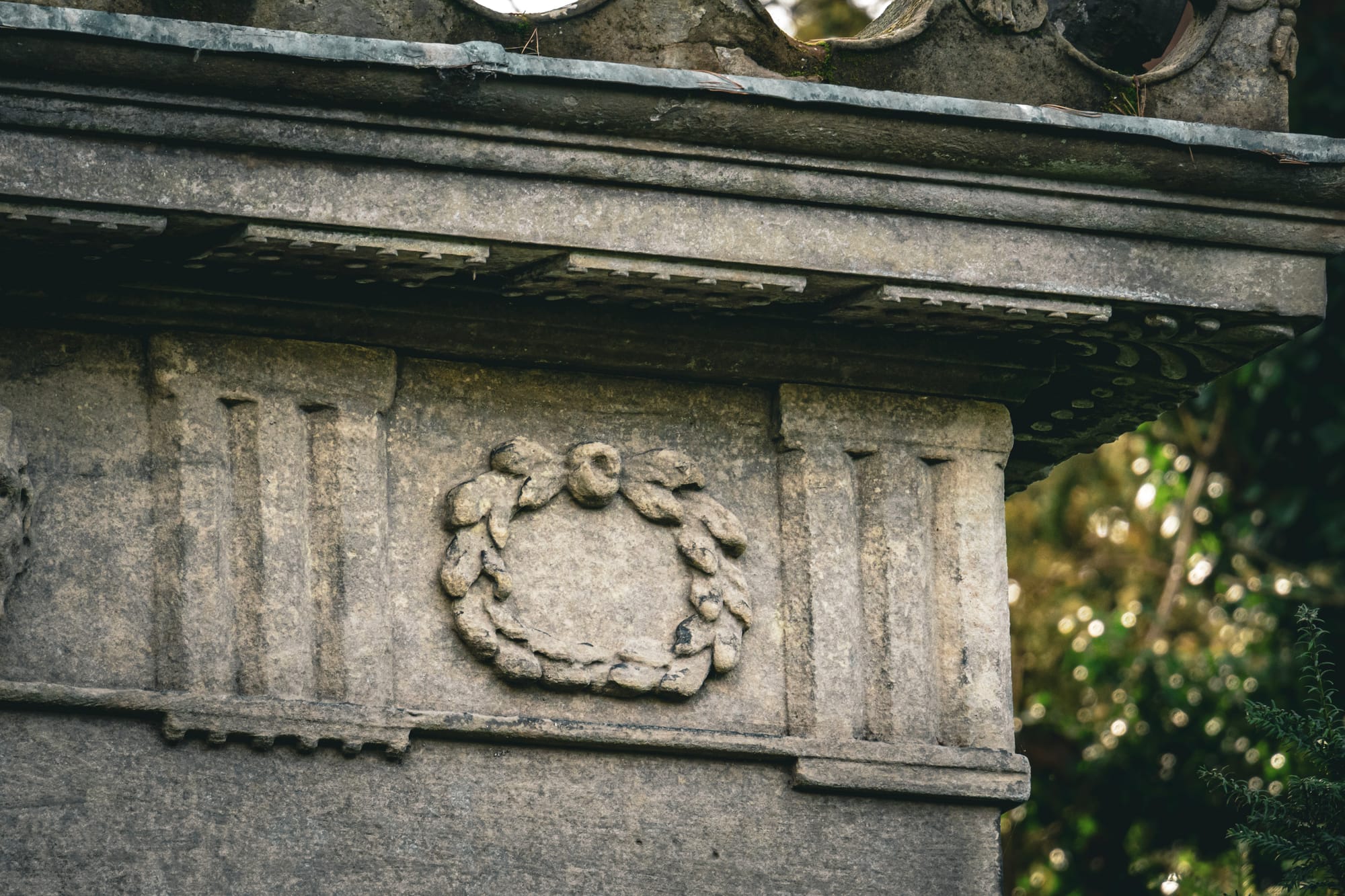
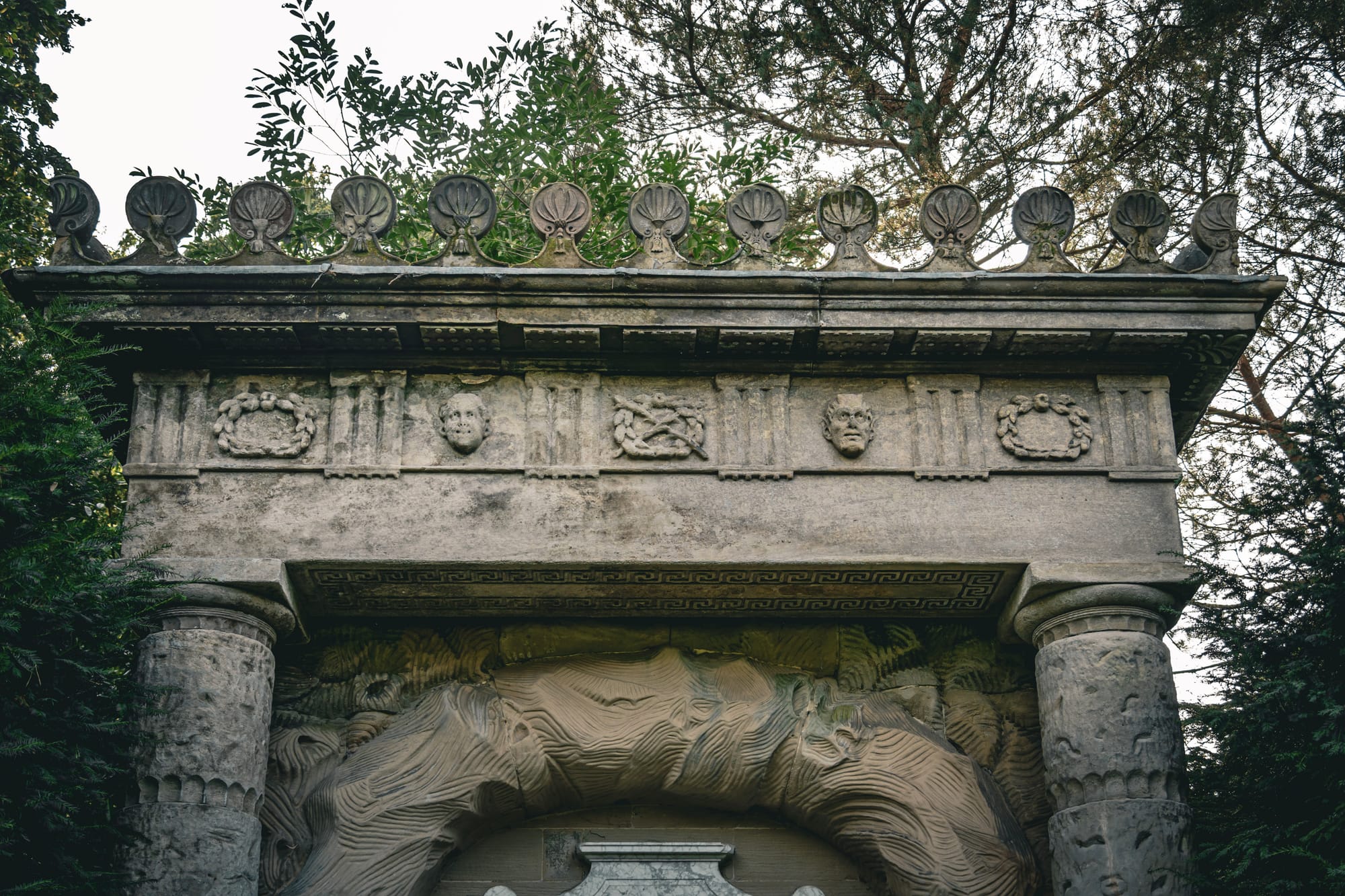
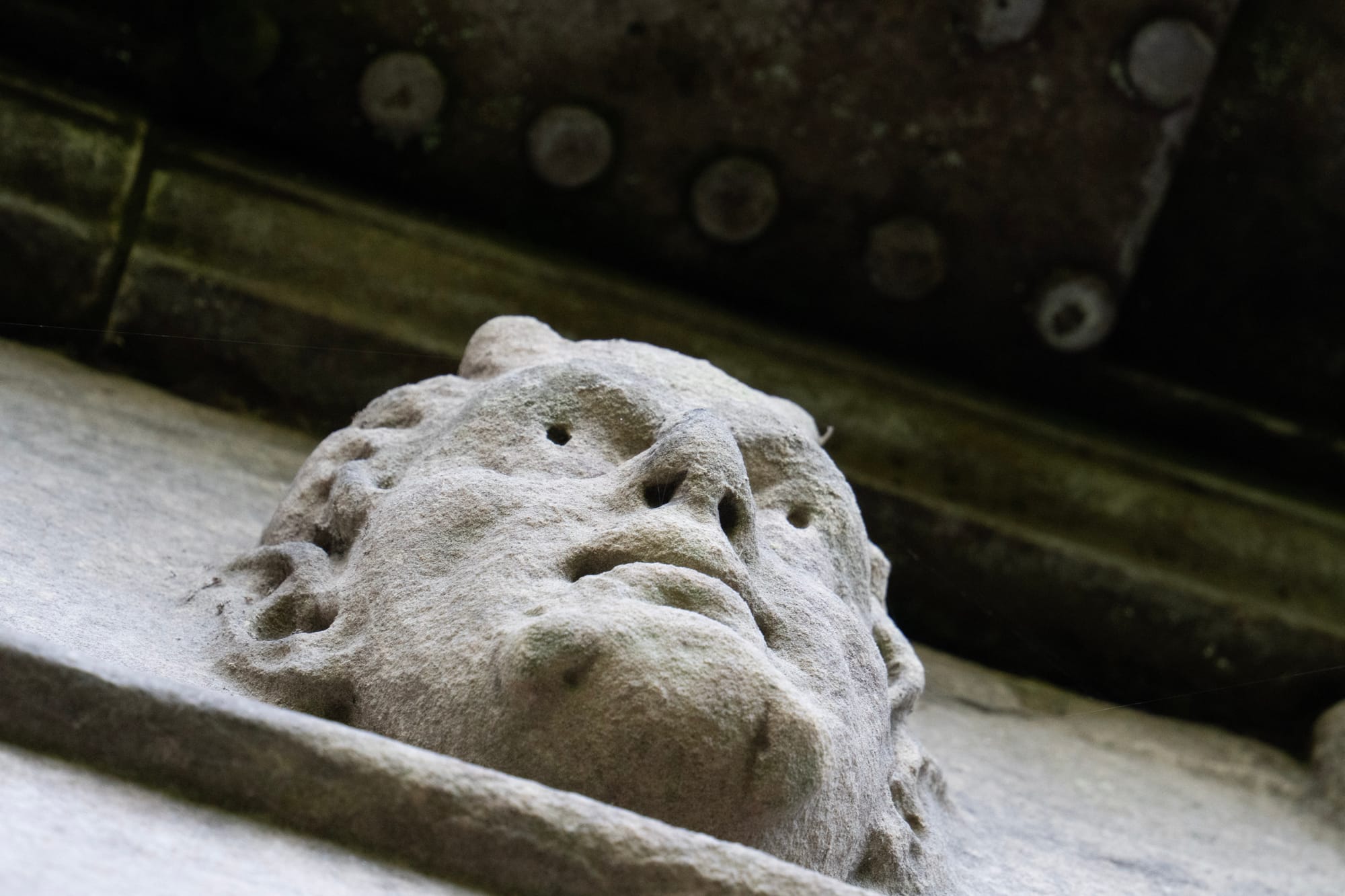
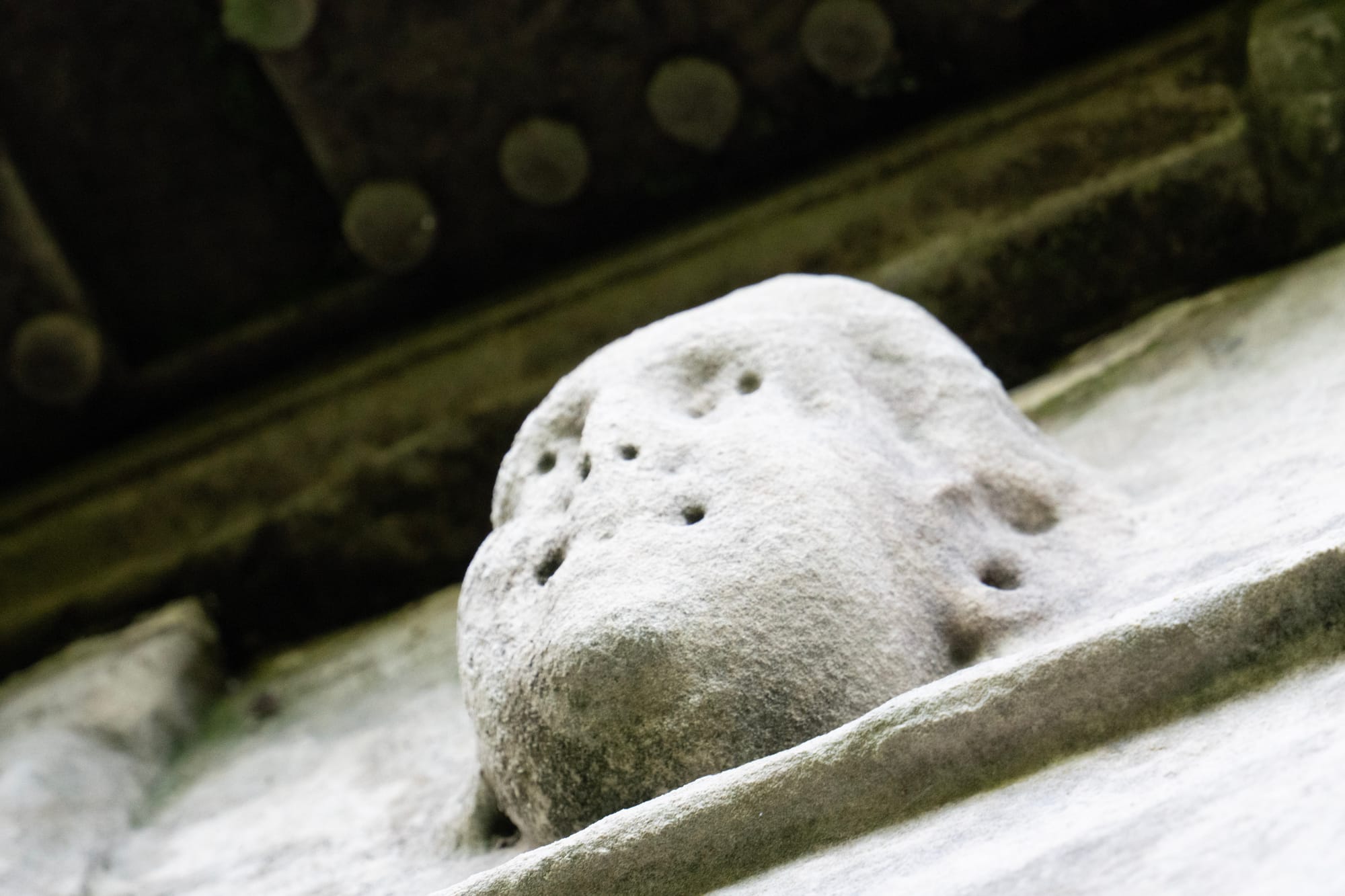
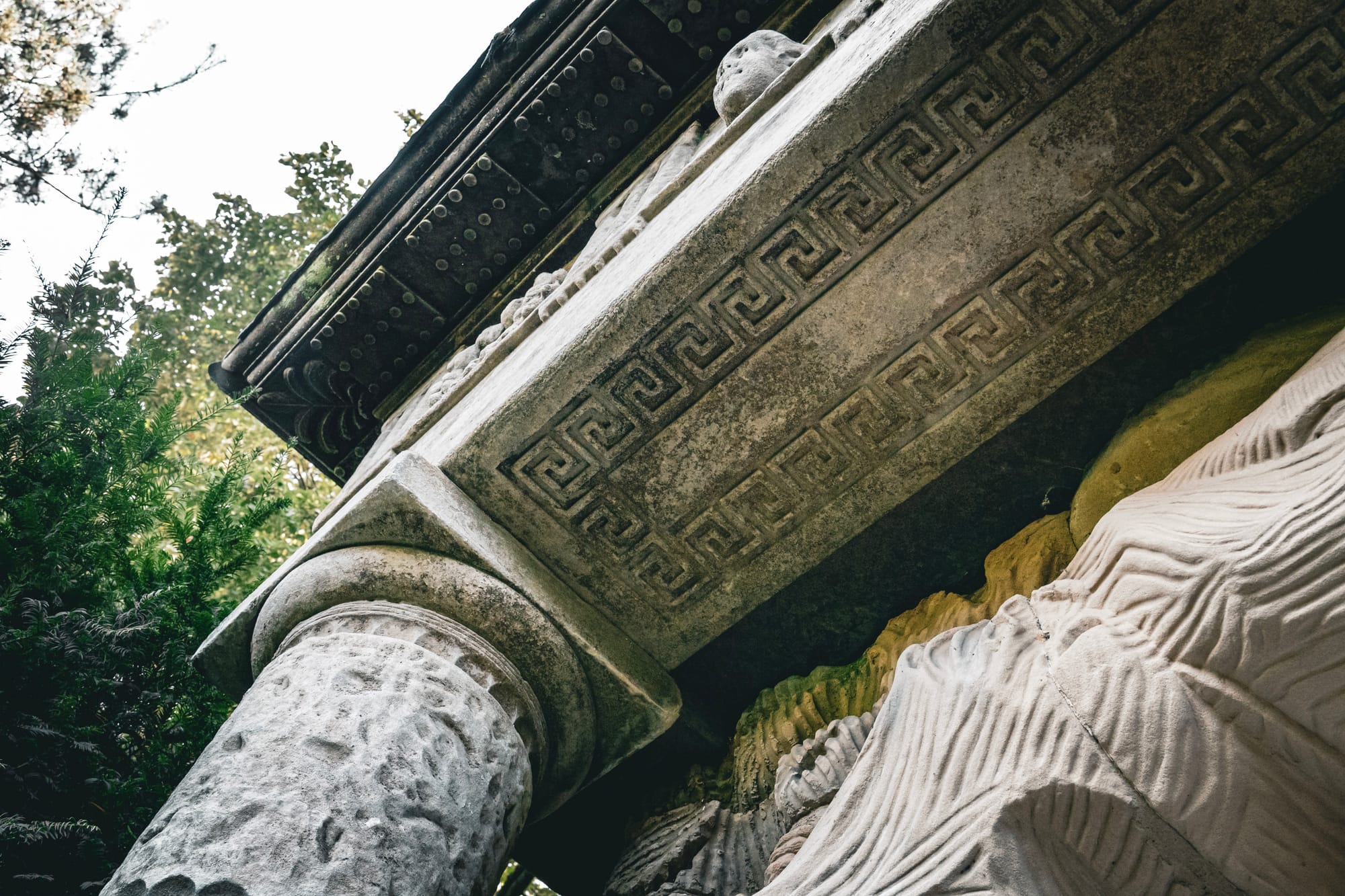
Details of the Shepherd's Monument's neoclassical portico, added around 1763 and attributed to James "Athenian" Stuart. Photos: Jenna Goodwin / The Red Haired Stokie
A famous painting, carved in reverse
Inside the arch is a marble relief by Peter Scheemakers, the Flemish sculptor responsible for the Shakespeare memorial in Westminster Abbey. It reproduces Nicolas Poussin's painting Et in Arcadia Ego (The Shepherds of Arcadia), painted in the 1630s, in which shepherds gather round a tomb in an idealised landscape and trace the Latin inscription on it: a reminder that death is present even in paradise.
Scheemakers worked from an engraving rather than the painting, so the whole scene is a mirror image of the original. He also made changes. A second, smaller sarcophagus sits on top of the main tomb, which appears nowhere in Poussin's work, and two of the shepherds point directly at particular letters in ET IN ARCADIA EGO, the N and the R.
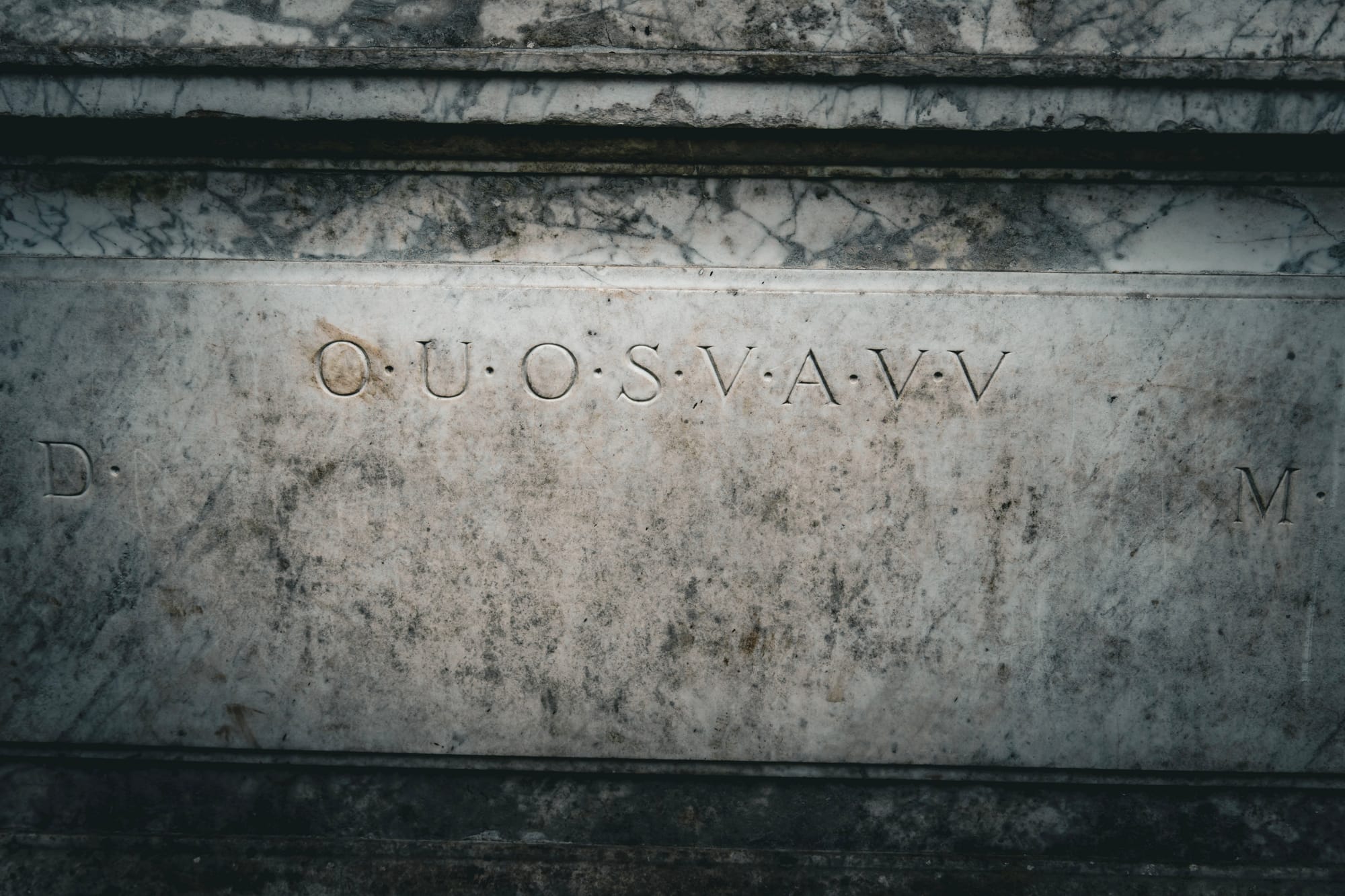
Below the relief is the plaque:
O U O S V A V V
D M
The D and M are the least of the mystery. They are the standard Roman funerary abbreviation Dis Manibus, "to the spirits of the departed", found on thousands of ancient tombstones. The eight letters above them are the problem. One detail matters: the U. A classical Roman inscription would use V throughout, so the letters were composed in the 18th century rather than copied from an ancient source.
The monument was praised in verse as early as 1750 by the Rev. Sneyd Davies, but the letters themselves were not recorded in print until 1817, in Sir Thomas and Arthur Clifford's history of nearby Tixall. By then, anyone who knew their meaning was dead.
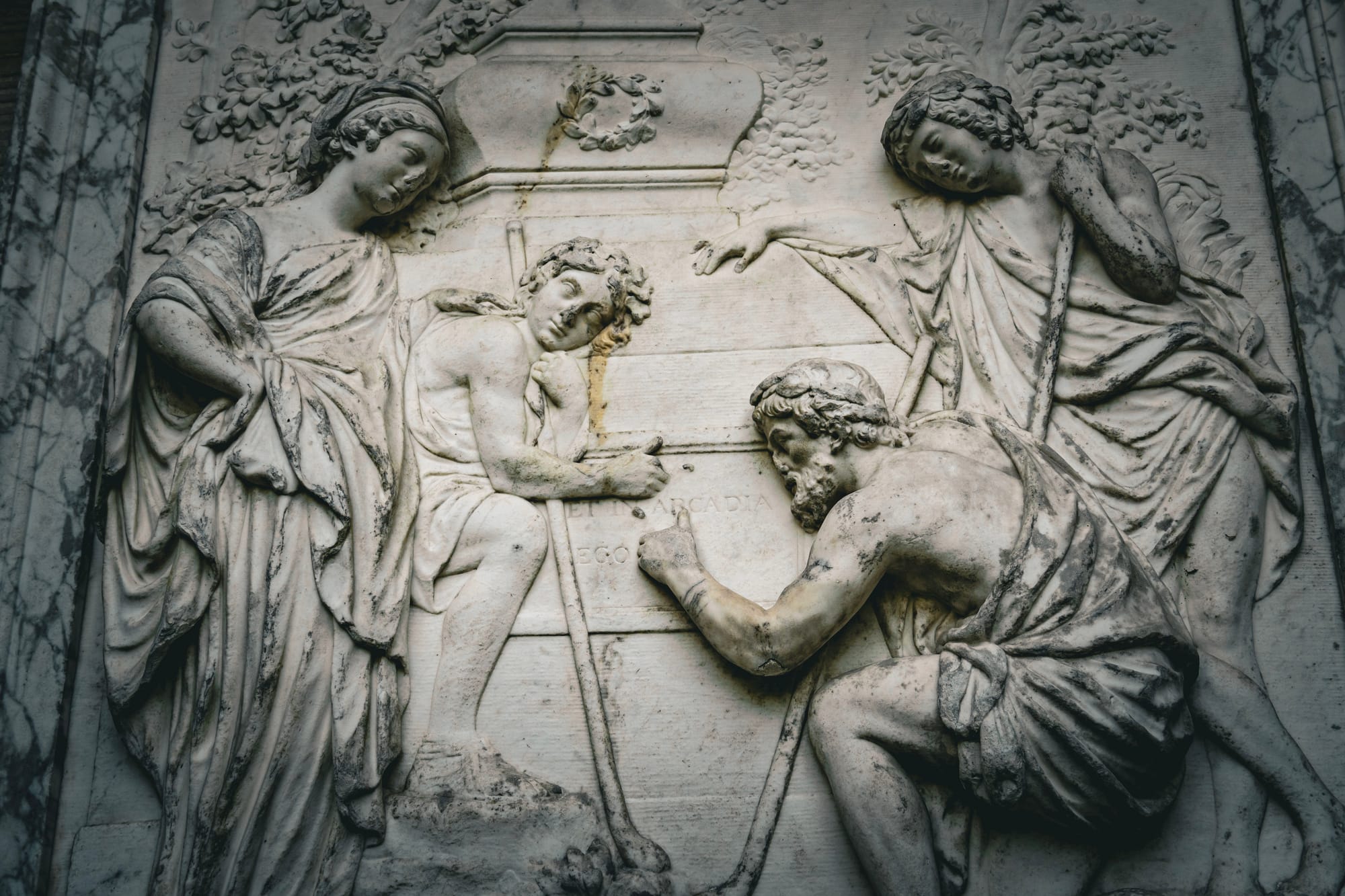
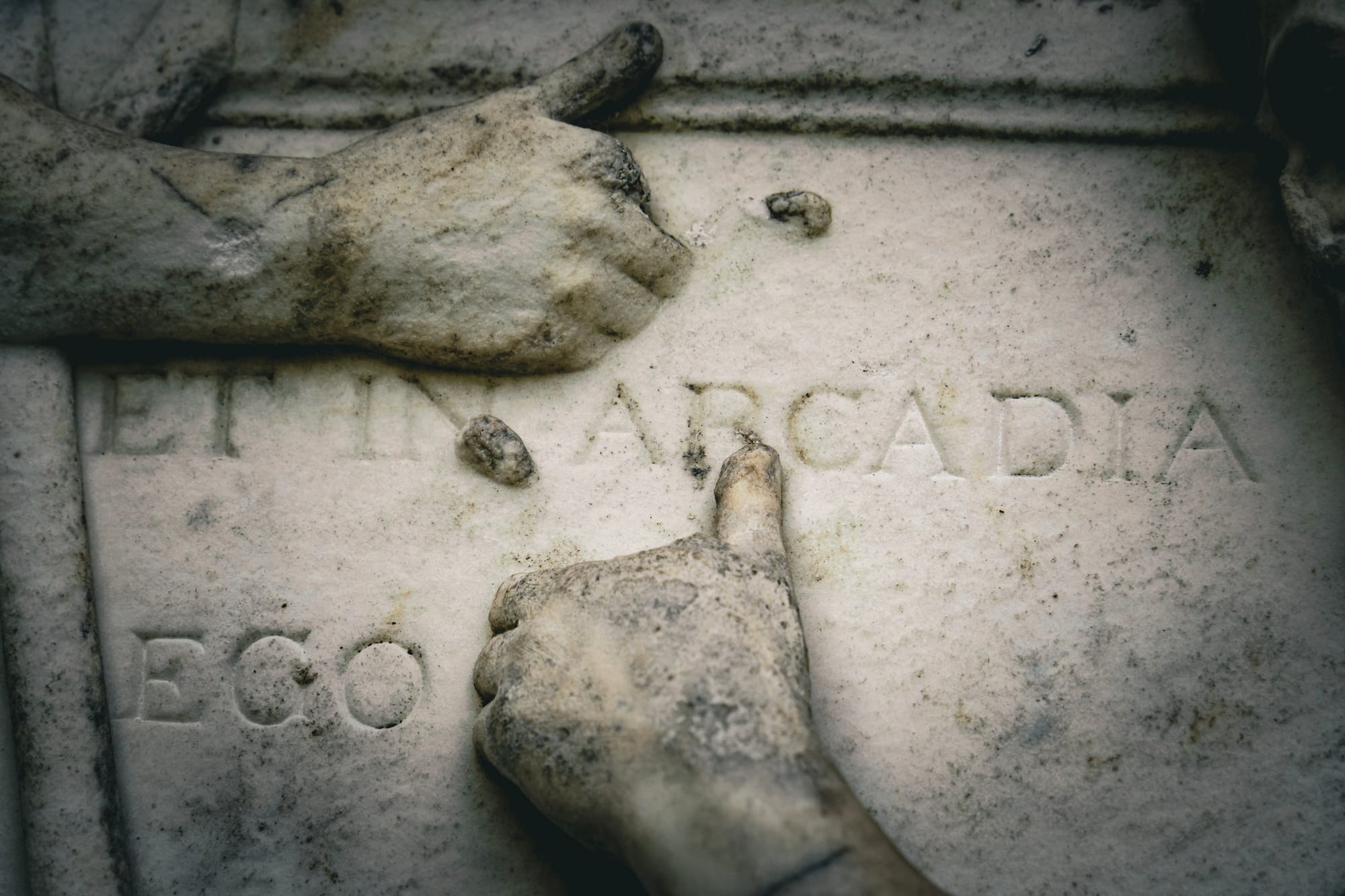
Peter Scheemakers' marble relief inside the arch, a mirror-image copy of Nicolas Poussin's Et in Arcadia Ego. Note the shepherd's finger resting on the letters of the tomb inscription. Photos: Jenna Goodwin / The Red Haired Stokie
What it meant to Thomas Anson
The earliest clue comes from the Welsh travel writer Thomas Pennant, who visited Shugborough in Anson's lifetime. He recorded that Anson would sit alone before the relief for long periods, and that it was intended partly as a general memento mori and partly, it was said, as a memorial to a heartbreak from his youth that he never discussed. Thomas Anson never married.
After the Ansons, the plaque became a puzzle for notable visitors. Josiah Wedgwood, a keen student of classical design, is said to have examined it. So did his grandson Charles Darwin, whose mother Susannah was a Wedgwood, and Charles Dickens. None of them produced an answer.

Shugborough - Monument: sepia drawing'Monument in the Garden at Shugborough, Staffordshire,' showing the Shepherd's Monument, a substantial building with a cornice resting on two rusticated Doric pillars, heavily carved. There is a relief ...View Full Resource on Staffordshire Past Track
How the Holy Grail got involved
For two centuries the monument was a local curiosity. That changed in 1982 with The Holy Blood and the Holy Grail by Michael Baigent, Richard Leigh and Henry Lincoln. The book claimed that Jesus married Mary Magdalene, that their bloodline survived in France, and that a secret society called the Priory of Sion, backed by the Knights Templar, had guarded the secret for centuries. Nicolas Poussin, the authors said, was a Grand Master of the Priory who hid clues in Et in Arcadia Ego.
 See all
Shugborough, with its reversed copy of that painting and an unreadable code beneath it, earned a mention as a possible pointer to the Grail. In 2003 Dan Brown borrowed the Priory, the bloodline and the coded artworks for The Da Vinci Code, and the story went global. Shugborough does not appear in the novel, but the book sent millions of readers back to its 1982 source, and the monument was soon being described as Britain's real-life Da Vinci Code.
The Priory of Sion, however, was a hoax. It was invented in 1956 by Pierre Plantard, who forged medieval genealogies and planted them in the Bibliotheque nationale in Paris to support a claim of royal descent. He admitted the fraud under oath in 1993. Neither Poussin nor the Ansons had any connection to it.
Bletchley Park, 2004
At the height of Da Vinci Code interest, Shugborough's estate manager Richard Kemp launched a campaign with the Bletchley Park museum in May 2004 to crack the code. Solutions arrived from around the world and were assessed by wartime codebreakers Oliver Lawn, who had worked on the Enigma and Lorenz ciphers, and his wife Sheila.
Their verdict was blunt. Eight letters is far too short for mathematical codebreaking: a string that length can be made to fit thousands of grammatical phrases in Latin, English or French, with no way to prove which is right. The inscription was almost certainly an acronym, the initials of a phrase meaningful to the Ansons, and the answer lay in family papers and 18th-century literature rather than cryptography.
Sheila Lawn favoured the reading of a widower's memorial. Oliver Lawn gave qualified credit to an anonymous American defence researcher whose decryption grids produced the phrase "Jesus (As Deity) Defy", supposedly a heretical creed of the Priory of Sion, while noting it rested on a chain of assumptions. The campaign generated worldwide headlines, thousands of submissions, and no solution.
The leading theories
A widower's memorial (Oliver Stonor, 1951). Optimae Uxoris Optimae Sororis Viduus Amantissimus Vovit Virtutibus: "Best of wives, best of sisters, a most devoted widower dedicates this to your virtues". It fits the funerary D M, but Thomas Anson never married and the Admiral's wife outlived him.
A friend's wife (Jack Mitchell, Antigone, 2022). Optimae Uxoris Optimi Sodalis Viri Annae Venables-Vernon, a memorial to Anne, wife of George Venables-Vernon of Sudbury, Anson's close political ally. The most recent scholarly reading, and one that explains why the meaning stayed private.
Ecclesiastes (Steve Regimbal). Orator Ut Omnia Sunt Vanitas Ait Vanitas Vanitatum, "vanity of vanities, all is vanity". Anson's friend George Lyttelton had OMNIA VANITAS carved at his estate at Hagley, and the two swapped garden ideas.
A prayer (Keith Massey). The former NSA linguist proposed Oro Ut Omnes Sequantur Viam Ad Veram Vitam, "I pray that all may follow the Way to True Life", after John 14:6.
Family estates (A. J. Morton). Orgreave United with Overley and Shugborough, Viscount Anson Venables Vernon, a 19th-century shorthand for Anson property and titles. Unromantic, but it accounts for the U.
The shepherdess Alicia (Margaret, Countess of Lichfield). Lines from a poem about a Roman shepherdess who converted pagans: Out Your Own Sweet Vale, Alicia, Vanishes Vanity. No such poem has been found, though the Countess noted that 18th-century lovers scratched "I L U" into window glass with diamond rings, so a message in initials was not unusual.
Mary Magdalene (Dave Ramsden, 2014). The monument as an altar to a shepherdess figure, the letters a shifting cipher for MAGDALEN.
Anson's gold (George Edmunds, 2016). Latitude and longitude for a Pacific island where the Admiral supposedly buried Spanish treasure.
Oak Island. Letter values totalling 2,810, claimed as the distance in miles to the Money Pit in Nova Scotia. Treat the two Vs as a Roman numeral ten and another reading yields the anagram DEVOUT MASON.
And the rest. Nostradamus, UFOs, a Templar tablet, Turkish sea charts matching bumps in the weathered stone, and a Hebrew reading of "Why Feather Curve", whose author searched the monument for a feather. There isn't one.
Shugborough since the Ansons
- The monument was listed Grade II* in 1953. The estate passed to the National Trust in 1960 in lieu of death duties, was leased to Staffordshire County Council, and returned to full National Trust management in 2016.
- Its shaded, damp position is poor for stone. By the 2000s the marble was flaking and crusted with sulphates, and in 2010 the National Trust completed a major conservation project, improving drainage, thinning the tree canopy and consolidating the carving.
- A fragment of the wooden lion figurehead from HMS Centurion, rescued by the 3rd Earl of Lichfield, is kept at Shugborough.
- The Trent Valley line passes beneath the park in a tunnel. Deer rest on the grass above it, and rare English Longhorn cattle graze the parkland.
- Patrick Lichfield, the 5th Earl, royal photographer and cousin of Queen Elizabeth II, kept apartments in the house until his death in 2005 and hosted guests including Princess Margaret, Mick Jagger and Britt Ekland.
- A local theory notes that the reversed letters the shepherds point at, N R, read R N the right way round, and links them to Captain Edward Wheeler RN and a 1750s inheritance dispute over Wootton Lodge near Ellastone.
So, is the Holy Grail hidden in a Staffordshire garden?
Almost certainly not. The only link between Shugborough and the Grail runs through a French forgery from 1956, and the U on the plaque rules out anything ancient. What the evidence supports is an 18th-century private memorial: a message in initials, composed by or for a scholarly bachelor with a naval fortune, contemplated in private, and never written down. The National Trust's official position is that it remains an uncracked private code or family memorial.
The most convincing readings are the quiet ones, a lost love, a friend's wife, a verse from Ecclesiastes. But with eight letters and no key, the inscription can never be proved either way, which is exactly why it still draws people to a hollow beside the River Sow.
Shugborough Estate, Milford, Stafford, ST17 0UP, is run by the National Trust and is about half an hour from Stoke-on-Trent via the A34 or A51. The Shepherd's Monument stands in the gardens near the river, a short walk from the mansion.