
The Women Who Were Told They Couldn’t Paint: A Hidden Story from the Stoke Potbanks
In 1859, a Victorian diarist touring the Stoke potbanks asked why women weren’t allowed to paint freehand. He was told they simply lacked the skill, and that their unsteady brushwork proved it. But the women of the Potteries were never short of talent; they were sabotaged.

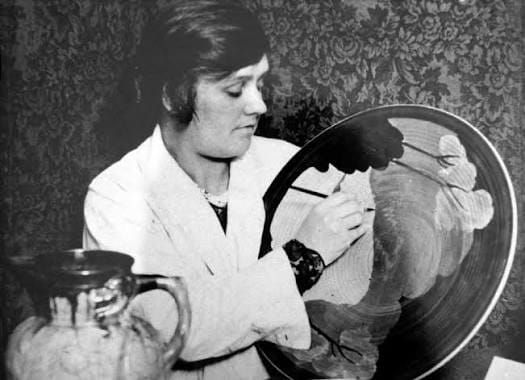
The paintresses of the Potteries were never short of talent, but for a long time they were short of something far more ordinary.
I have spent years reading about the women who worked on Stoke’s potbanks, and I thought I was long past being surprised by anything I found, until I came across the story.

In 1859 a London barrister named Arthur Munby began keeping the diary that would eventually make his name. Munby had an unusual interest for a Victorian gentleman of his class, in that he was fascinated by working women, and over the following decades he travelled across Britain to meet pit girls, fisher girls, farm labourers and factory hands, recording in remarkable detail the work they did, the hours they kept and the wages they were paid. His diaries, which run to dozens of volumes, are now held at Trinity College, Cambridge, and they remain one of the richest sources we have on the lives of working women in the second half of the nineteenth century.
The Potteries offered him plenty to observe. Work on the potbanks was divided firmly along lines of sex, with men holding the skilled, respected and better-paid positions such as throwing, turning and freehand painting, while women and girls were confined largely to auxiliary and lower-paid tasks. They turned the heavy wheels that powered the throwers and turners, carried boards of moulds back and forth to the drying stoves, wedged clay to drive out the air, and applied printed transfers to biscuit ware. It was labour without which the works could not have run, yet it was paid at a fraction of the rate the men received.
As the story is told, Munby asked why women were not permitted to paint freehand, and was given an answer that would have been familiar in almost any workplace of the period. Women, he was told, simply lacked the skill of hand required for fine decoration, and the evidence lay in their brushwork, which was shakier and less even than that of the men. It was a tidy explanation, but it left something out, and Munby noticed what it was when he looked at what the painters were sitting on. The men worked on sturdy wooden chairs fitted with arms, while the women worked on armless chairs and stools.

Paintresses Decorating China. Photographed by William Blake.Lantern slide showing paintresses decorating ware.This lantern slide appears to be one of a group used for a presentation or slide show by Blake entitled “Staffordshire Pottery.” A small folder containing ...View Full Resource on Staffordshire Past Track
The difference was far from trivial. Fine brushwork depends on a steady hand, and a steady hand depends on a supported arm, since a painter able to rest an elbow on a solid surface can hold a brush still for hours at a time. Without that support, the full weight of the arm must be held by the muscles of the shoulder throughout the working day, and as those muscles tire the hand inevitably begins to tremble. The women’s lines therefore wavered, that wavering was taken as proof that women could not paint, and because women could not paint there was no reason to provide them with the chairs the men enjoyed. The reasoning sustained itself perfectly, and it had nothing whatever to do with ability.

Burgess & Leigh, MiddleportThe decorating room at Burgess & Leigh's pottery, Middleport, Stoke-on-Trent. Paintresses are hand decorating dishes.Established in 1851, Hulme and Booth's Central Pottery in Burslem was taken over ...View Full Resource on Staffordshire Past Track
Munby is said to have pressed the point further, observing that some of the women painted well regardless, producing steady work without any support at all, and asking why they were not moved up into the better-paid departments. The reply he received was candid: the men would not stand for it. That answer explains a great deal about how the potbanks operated. Women were paid considerably less than men, and skilled male workers, organised through their trade societies, had every reason to keep cheaper labour out of their departments and protect the rates they had fought for. Employers, for their part, had little to gain from provoking a dispute by promoting women into men’s work. No formal rule was needed to keep women away from fine painting when the conditions of the shop floor achieved the same result quietly and without argument.
The women of the Potteries did not remain at the margins for ever. Over the decades that followed they moved steadily into the decorating shops, and by the 1920s and 1930s the freehand paintresses were widely regarded as the elite of the shop floor. Three of them, Charlotte Rhead, Clarice Cliff and Susie Cooper, rose from the painting bench to become designers in their own right, with their names carried on the backstamps of the ware they created. Even then, as former paintresses later recalled, their pay never quite matched the standing they had earned.
The design historian Cheryl Buckley explored this history in her book Potters and Paintresses, demonstrating that “skill” in the pottery industry was never a neutral measure of ability but a status, granted to some workers and withheld from others, whose absence could then be pointed to as evidence that it had never existed in the first place. Clarice Cliff is often described as a remarkable exception, and in many ways she was, but it may be more accurate to see her as one of the women who finally made it past the furniture. Which leaves a question that no archive can answer. If Rhead, Cliff and Cooper could achieve so much once the door was finally opened, what might the generations of women before them have created, designed and built in all those years when they were held down, and how much of Stoke’s story was never allowed to be written at all?
 The Red Haired Stokie
You can now pre-order my 2027 Stoke-on-Trent calendar!